
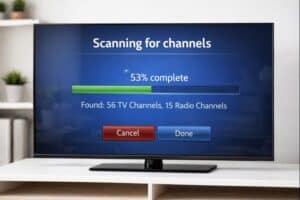
Why Retuning Often Makes TV Problems Worse
If you’ve retuned your TV to fix missing channels or reception issues and things have actually got worse, you’re not alone. Retuning is often suggested as a quick fix, but in many cases it doesn’t solve the real problem — and can sometimes create new ones.
Below, we explain why this happens, what a retune actually does, and when it’s time to stop retuning and get the signal checked properly.
What a Retune Actually Does
When you retune your TV, it scans for available signals and stores the strongest versions it finds at that moment. It doesn’t repair aerials, cables, or signal faults — it simply reacts to whatever signal quality is present during the scan.
If the signal is weak or unstable, the TV may:
- Store channels from the wrong transmitter
- Lose previously stable channels
- Mix channels from different transmitters
This is why retuning often gives unpredictable results.
Common Freeview Problems After Retuning
After a retune, people often notice:
- Missing channels
- Duplicate channel numbers
- Channels appearing in the wrong order
- More frequent picture breakup
- Complete loss of certain channel groups
These symptoms usually point to a signal issue rather than a tuning problem.
Why Repeated Retuning Is a Bad Idea
Repeated retuning can make things worse because the TV keeps overwriting previously stored channels. If the aerial system isn’t delivering a clean, stable signal, each retune just reshuffles the problem rather than fixing it.
In some cases, retuning during poor signal conditions can lock the TV onto a much weaker transmitter, causing ongoing reception problems.
When a Retune Won’t Fix the Problem
A retune won’t help if:
- The aerial has moved or degraded
- Cabling or wall plates are damaged
- The signal is marginal or affected by weather
- The system is over-amplified or incorrectly split
In these situations, the underlying issue needs to be resolved before tuning will work properly.
Local Experience Makes a Difference
We regularly fix Freeview reception problems across Sussex and surrounding areas. In coastal and hilly locations especially, signal conditions can change over time, making retuning ineffective without addressing the aerial system itself.
