Local TV Aerials and Satellites

LTV - big enough to cope, small enough to care

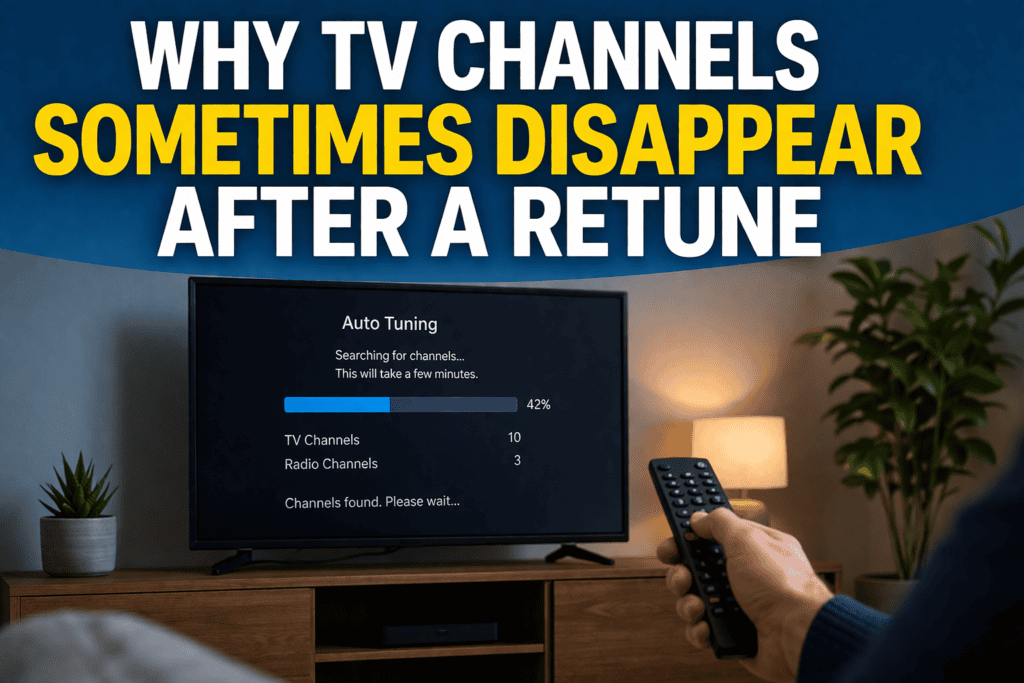
Why TV Channels Sometimes Disappear After a Retune

tv channels disappear after retune

When TV channels suddenly disappear, many people immediately try retuning their television.

It seems like the obvious fix. After all, if channels are missing, scanning again should bring them back.

But in practice, retuning often makes reception problems appear worse rather than better.

Across East and West Sussex we regularly see situations where a perfectly good set of channels disappears after a retune, even though the aerial system itself hasn’t actually changed.

Understanding why this happens can help avoid unnecessary frustration.

What a Retune Actually Does

When you run a retune, the television scans the available broadcast frequencies and stores whichever signals it detects at that moment.

The important detail is this: the TV only stores channels that are present during the scan itself.

If a signal is weak, unstable or temporarily missing while the retune runs, the TV simply won’t store that multiplex at all.

This means the channels carried on that frequency disappear completely from the channel list.

Temporary Signal Problems

Digital TV signals can fluctuate slightly due to weather conditions, transmitter work or interference.

If a retune happens during one of these temporary dips, the television may fail to detect the signal properly.

Once the scan finishes, the channels are gone, even though the signal might return a short time later.

In other words, the retune didn’t fix the issue; it simply removed the channels from the TV’s memory.

Aerial Alignment Issues

Another common cause of missing channels after a retune is slight aerial misalignment.

If the aerial has shifted slightly due to wind or ageing brackets, certain frequencies may be weaker than others.

During everyday viewing this might appear as occasional picture break-up.

But during a retune, those weaker frequencies might not be detected at all.

The result is that entire groups of channels vanish from the television.

Multiplexes and Why Whole Channel Groups Disappear

Freeview channels are transmitted in groups known as multiplexes.

Each multiplex carries multiple channels.

If one multiplex is not detected during a retune, all of the channels within that group disappear at the same time.

This is why people often report losing several channels together, rather than just one.

Why Repeated Retuning Often Makes Things Worse

When channels disappear, it is tempting to run the retune again.

Unfortunately this can compound the problem.

If the signal conditions are still unstable, the TV may store a different set of channels each time the scan runs.

This leads to confusing situations where channels appear, disappear and move around the channel list.

Repeated retuning can therefore turn a minor reception issue into a much bigger headache.

When Retuning Is Actually Necessary

There are only a few situations where retuning is genuinely required.

These include:

  • when a transmitter changes frequency
  • when a new TV is installed
  • after a factory reset of the television

Outside of these cases, retuning rarely solves reception problems.

If channels disappear unexpectedly, the underlying issue is usually related to the aerial system rather than the television itself.

Common Causes of Missing Channels

When channels disappear after a retune, the most common causes are:

  • aerial movement after wind or storms
  • ageing or damaged coaxial cable
  • loose wall plate connections
  • signal interference
  • poorly balanced distribution systems in homes with multiple TVs

Each of these problems affects signal quality rather than simply signal strength.

Why Signal Diagnosis Matters

Modern digital TV requires a clean and stable signal.

If the signal arriving at the television is inconsistent, the TV cannot reliably store or display the channels.

This is why proper signal testing is far more effective than repeatedly retuning the television.

Once the root cause is identified and corrected, the channels can usually be restored quickly and remain stable.

Reliable TV Reception Across Sussex

Across East and West Sussex, signal conditions can vary depending on terrain, coastal influences and property layout.

Aerial systems that worked perfectly for many years can gradually develop faults as equipment ages or weather conditions take their toll.

The key is identifying the underlying cause rather than relying on guesswork.

When the aerial system is properly aligned, the cabling is sound, and the signal is balanced correctly, Freeview reception should remain stable without the need for repeated retuning.

Book An Engineer

Frequently Asked Questions

How quickly can you attend my property?

In most cases we can offer a same-day or next-day visit, with a two-hour arrival window so you’re not waiting in all day. Emergency TV aerial and satellite faults are treated as a priority, and we’ll always be honest about the earliest slot we can realistically make.

We don’t charge just to talk to you. We’ll usually visit, test the signal and give you a free, no-obligation estimate before any work is done. If you’re happy with the price, we can normally complete the installation or repair during the same visit. You’ll always know the cost upfront.

We’re based in the South East and regularly work across East Sussex, West Sussex and surrounding areas, covering both towns and rural locations. If you’re unsure whether we cover your address, just give us your postcode and we’ll confirm.

We install and repair TV aerials, satellite dishes, Freeview and Freesat systems, as well as multi-room TV points, TV wall mounting, Starlink and satellite broadband, communal systems, CCTV, Wi-Fi alarms, network cabling and home/office networking. If it involves reception, cabling or connectivity, we can usually help.

Most modern aerials will cope with digital services like Freeview and Freely without issue, but older or damaged aerials can struggle after the digital switchover. We can test your existing aerial using professional meters and advise whether a repair or upgrade will give you the best long-term reliability.

Yes. Break-up or pixelation can be caused by a misaligned aerial, a damaged dish, water-damaged cables, worn connectors or issues with boosters and splitters. We test the signal at your aerial and at each TV point to identify the fault, and most reception problems can be fixed during the first visit.

We install roof-mounted aerials, loft aerials and specialist high-gain or log-periodic aerials. Roof aerials usually give the cleanest signal. Loft aerials are suitable where access or appearance is an issue, but they can be more sensitive to interference. We’ll recommend what gives you the most reliable reception in your specific location.

  • Freeview (and the newer Freely-style services) use a standard TV aerial.
  • Freesat and Sky use a satellite dish.
  • Subscription services offer more channels and on-demand content.
  • Streaming services (Netflix, iPlayer, Prime Video, etc.) are delivered through your broadband, not your aerial or dish.
  • We can help you set up whichever combination gives you the best choice and the most stable signal.

Yes. We can add extra aerial or satellite points in bedrooms, kitchens, loft conversions and offices, and we can design proper distribution systems so that every TV gets a strong, balanced signal without interference. For satellite and Starlink systems we can also route new cabling neatly and safely.

Yes. We install and mount Starlink systems, providing safe cable routing into the property, secure brackets or poles, and integration with your existing Wi-Fi and network hardware. Starlink is especially useful in rural areas where broadband speeds are low or unreliable.

Yes. We install CCTV, Wi-Fi alarms, Ethernet cabling, access points, network switches and 4G/5G router setups. This allows us to give you a complete, reliable setup for TV, internet and security systems using one team.

All engineers are fully trained, insured and DBS-checked. Our team works to industry standards, uses modern equipment and follows best practice for safety and reliability. You’re always dealing with professional, experienced installers.

Yes. We design and maintain communal aerial and satellite systems, as well as IRS systems and commercial TV networks for flats, hotels, pubs, offices, gyms and other multi-screen environments. We regularly work with landlords, property managers and building contractors.

All new installation work comes with at least a 12-month guarantee on parts and labour. Many components carry longer manufacturer warranties. If anything related to our work goes wrong during the guarantee period, we’ll return and put it right.

Your engineer will arrive within the agreed window, discuss the issue with you and check access. They’ll test the signal, inspect your existing equipment, explain the options and confirm the price before starting. Once the job is done, they’ll retest everything, show you it working, and tidy up. Old or unsafe equipment can be removed if needed.