TV Aerials Help
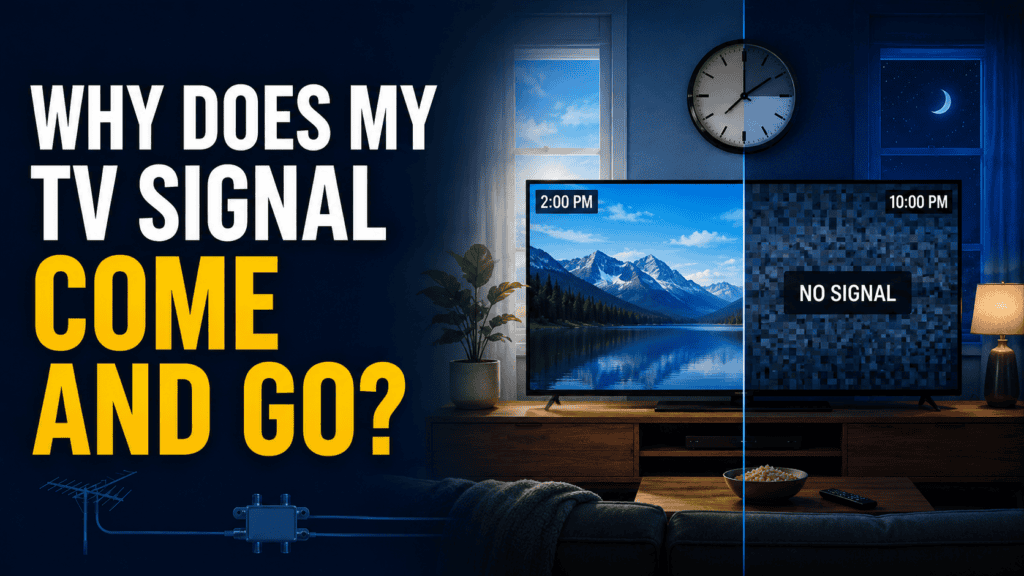
One of the most annoying TV aerial problems is when the signal is not bad all the time. One minute, the picture is fine. Later in the day, it starts breaking up. Some channels work in the morning but disappear in the evening. The TV may freeze, pixelate, lose sound, or show “no signal” for no obvious reason.
Why Does Your TV Signal Come and Go?
This kind of fault can be more frustrating than a complete loss of signal because it makes the problem harder to understand. If the aerial was broken, surely it would be broken all the time?
Unfortunately, TV signal problems do not always behave neatly. A signal can be just strong enough to work at one time of day, then drop below a reliable level later. That is why intermittent faults often need proper testing rather than guesswork.
A Borderline Signal Can Look Random
Digital TV can be unforgiving. With older analogue television, a weak signal often produced a snowy picture. With digital TV, the picture may look perfect until the signal drops below a certain point. Then it can suddenly break up, freeze or vanish completely.
This means a small change can make a big difference.
If your signal is already borderline, changes in weather, atmospheric conditions, interference, cable performance or electrical noise can push it over the edge. The TV may work well for hours, then suddenly become unreliable.
That does not necessarily mean the aerial has completely failed. It may mean the whole system is only just good enough, and something is causing the signal to dip at certain times.
If your channels are disappearing as well as breaking up, our guide to why TV channels sometimes disappear after a retune explains why retuning is not always the right first step.
Why TV Signal Problems Can Be Worse in the Evening
Many people notice TV reception problems more in the evening. This is partly because that is when most people watch TV, but there can be other reasons too.
More electrical equipment may be in use. Lights, heating systems, chargers, routers, appliances and other devices can all add small amounts of electrical noise. In some cases, interference from nearby equipment can affect a weak or poorly protected aerial system.
Evening weather conditions can also play a part. Changes in temperature, pressure and moisture in the air can affect how TV signals travel, especially in areas where reception is already marginal.
In coastal areas of Sussex, reception can sometimes be affected by changing atmospheric conditions, sea air corrosion, wind and rain. The signal may not disappear completely, but it can become unstable enough to cause break-up or missing channels.
We explain this local issue in more detail in our guide to why TV signal problems are worse in coastal areas.
Weather Can Expose a Weak System
If your TV signal comes and goes during wind, rain, damp weather or very hot conditions, the weather may not be the original cause. It may simply be exposing a weakness that is already there.
For example, wind can move an aerial slightly if the mounting is loose or worn. Rain can affect damaged outdoor cable or connections where water has started to get in. Damp conditions can make an already poor connection worse.
Heat and cold can also affect older fittings, cable and equipment. Small movements or changes in resistance can be enough to make a borderline signal unreliable.
This is why a TV system can appear to work normally in calm, dry weather but become unreliable when conditions change.
Loose or Damaged Cables Can Cause Intermittent Faults
A loose cable is one of the most common causes of a TV signal that comes and goes.
The cable may not be fully secure at the TV, wall plate, splitter, booster or aerial end. The connection may work most of the time, then fail when it is moved slightly, affected by vibration, or disturbed by people, pets, furniture or cleaning.
Outdoor cable can also degrade over time. If the outer covering is damaged, water can get in. Once moisture enters the cable, the signal can become unstable. Sometimes the fault is worse during or after rain, which can make the problem seem weather-related.
Indoor cable can also be damaged by DIY work, decorating, furniture, tight bends, poor joins or low-quality fittings.
If one cable or connection is unreliable, the problem may come and go rather than fail completely.
Aerial Alignment Can Drift Over Time
A TV aerial does not always need to be dramatically damaged to cause problems. Sometimes it only needs to move slightly.
Wind, old brackets, loose fixings, roof work, scaffolding, storms or general wear can all affect aerial alignment. If the aerial is no longer pointing accurately towards the best transmitter, the signal may still work some of the time but become unreliable when conditions change.
This is especially likely where the signal was never particularly strong in the first place.
A small alignment issue may not cause a constant failure. Instead, you may get occasional pixelation, missing channels, sound dropouts or “no signal” messages.
That is why proper signal testing and aerial alignment checks are important. Looking at the aerial from the ground is not always enough.
Boosters Can Make Intermittent Problems More Confusing
A signal booster can help in the right situation, but it can also make intermittent signal problems harder to diagnose.
If the signal going into the booster is poor quality, the booster may simply amplify a poor signal. You may still get break-up, missing channels or freezing.
If the signal is already strong enough, too much amplification can overload the TV tuner. This can create symptoms that look like weak signal problems, even though the issue is actually too much signal or poor signal quality.
This is why adding a booster without testing the system can be a bit of a gamble.
In some homes, the booster is the problem. It may be old, failing, badly positioned, poorly powered, or unsuitable for the number of TVs being served.
For more detail, see our guide: TV signal booster: when it helps and when it makes things worse.
Interference Can Appear at Certain Times
Some TV signal problems are caused by interference. This can come from inside the home or from nearby properties.
Possible sources include faulty electrical equipment, LED lights, power supplies, routers, mobile devices, heating systems, appliances, tools, chargers or poorly screened cables. In some cases, interference only appears when a particular device is switched on.
This can make the problem seem mysterious. The TV may work perfectly until something else in the house starts running.
Interference does not always affect every channel equally. You may find that some channels are fine while others break up or disappear.
A professional signal check can help identify whether the problem is weak signal, poor signal quality, interference, cabling, amplification or aerial alignment.
Transmitter Work and Local Conditions Can Also Play a Part
Occasionally, signal problems may be caused by transmitter work or wider reception conditions. This is less common than household aerial faults, but it can happen.
If several neighbours are having the same problem at the same time, there may be a wider issue. If only your home is affected, the fault is more likely to be with your own aerial system, cabling, splitter, amplifier or TV setup.
Local geography can also matter. Hills, trees, buildings, cranes, scaffolding and nearby construction can all affect reception. In parts of Sussex, two houses on the same road can sometimes get different results because of roof position, line of sight and surrounding obstacles.
This is one reason why TV aerial advice cannot always be one-size-fits-all. The right solution depends on the property and the signal available at that exact location.
You can also check general reception information through Freeview Help.
Retuning Is Not Always the Answer
When channels disappear or start breaking up, many people immediately retune the TV. Sometimes this helps, but if the signal is unstable, it can make things worse.
If you retune while the signal is weak, the TV may fail to store channels that were previously there. It may store the wrong version of a channel, pick up a weaker transmitter, or make the channel list more confusing.
If your signal comes and goes, the better approach is usually to find out why the signal is unstable first. Once the signal is steady, a retune is much more likely to work properly.
Repeated retuning without fixing the signal fault can turn a simple problem into a more confusing one.
Different TVs May React Differently
If you have more than one TV in the house, you may notice that one copes better than another.
This does not always mean one TV is faulty. Different televisions and set-top boxes can handle weak or borderline signals differently. One may continue to show a picture while another breaks up or loses channels.
The cable route also matters. A TV connected to a shorter, cleaner cable may work better than one connected through a longer cable run, splitter, wall plate or booster.
So if one TV loses signal at certain times while another seems fine, the issue may be the feed to that room rather than the TV itself.
If this sounds familiar, our article on why your TV aerial works in one room but not another may also help.
What You Can Check Before Calling an Engineer
There are a few simple checks you can make before booking a visit.
Check that the aerial lead is firmly connected to the TV and wall socket. If possible, try a different fly lead. Look for obvious damage to cables, loose wall plates, poor plugs or anything that has recently been moved.
If the problem only happens on one TV, compare it with another room. If all TVs are affected at the same time, the issue may be closer to the aerial, splitter, amplifier or main feed.
If the problem happens after rain or wind, make a note of that. If it happens at a similar time each day, think about what else is being switched on around that time.
These clues can help an engineer diagnose the fault more quickly.
What an Engineer Will Usually Test
A proper signal check should look at both signal strength and signal quality. Strength alone is not enough. A signal can be strong but poor quality, especially if it is affected by interference, overload or faulty equipment.
An engineer may test the signal at the aerial, at the cable entry point, at splitters or amplifiers, at wall plates and at the TV itself. They may also check aerial alignment, cable condition, water ingress, damaged fittings and whether the system is suitable for the number of TVs in the property.
This is much better than simply replacing parts at random.
The aim is to find the actual cause of the intermittent fault, not just guess at the most obvious explanation.
For help with weak, unstable or missing channels, visit our fix my TV signal page.
Do You Need a Repair or a New Aerial?
If your TV signal comes and goes, the answer may be a simple repair. It could be a loose connector, faulty fly lead, damaged cable, failing amplifier or slight aerial alignment issue.
In other cases, the aerial system may be old, weather-damaged or poorly set up. If several parts of the system are ageing at once, a new aerial and fresh cabling may be the more reliable long-term option.
The key is proper diagnosis.
A reliable engineer should be able to explain whether the fault is likely to be repaired or whether replacement would be the better investment.
For more on this, read our guide: do I need a new TV aerial or can my existing one be repaired?
Need Help With a TV Signal That Comes and Goes in Sussex?
Local TV Aerials & Satellites can check your aerial system and find out why your TV signal is unreliable.
We can test the signal, inspect the aerial, check cables and wall plates, look at splitters and boosters, and advise whether you need a repair, adjustment, replacement cable, improved distribution or a new aerial.
We cover TV aerial repairs and signal problems across East Sussex and West Sussex, including Brighton, Hove, Lewes, Eastbourne, Seaford, Newhaven, Peacehaven, Uckfield, Haywards Heath, Burgess Hill, Horsham, Crawley, Hailsham, Bexhill and surrounding areas.
If your TV signal comes and goes, breaks up at certain times, or seems to vanish for no obvious reason, get in touch and we can help you find the most sensible fix.
TV Signal Comes and Goes FAQs
Why does my TV signal come and go?
A TV signal can come and go if the signal is borderline, the aerial has moved slightly, there is damaged cable, water ingress, interference, a faulty booster, poor connections or changing weather conditions.
Why is my TV signal worse at night?
Evening reception problems can be caused by changing atmospheric conditions, more electrical equipment being used, interference, or a weak aerial system that becomes unstable when conditions change.
Can weather affect my TV aerial signal?
Yes. Wind, rain, damp, heat and atmospheric conditions can all expose problems with an aerial system, especially if there are loose fittings, old cable, water ingress or marginal signal strength.
Should I retune when my TV signal disappears?
Not straight away. If the signal is weak or unstable, retuning can remove channels or store the wrong versions. It is better to fix the signal problem first, then retune once reception is stable.
Can a booster fix a TV signal that keeps dropping out?
Sometimes, but not always. A booster can help if the signal is suitable for amplification, but it can also make things worse if the signal is poor quality or already too strong. Testing is the safest way to know.
