
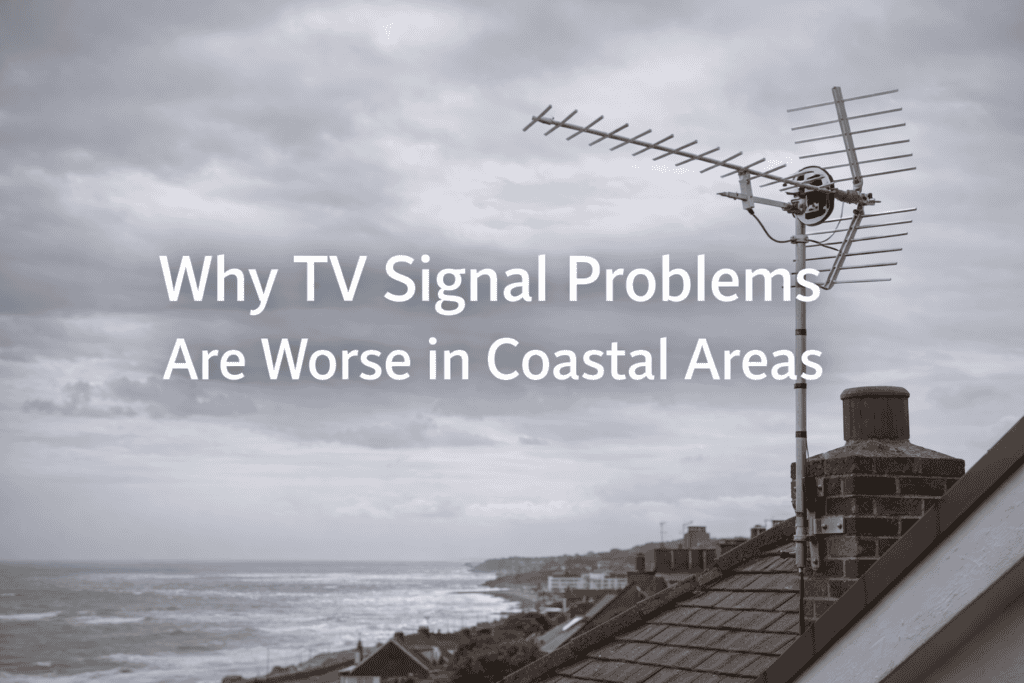
If you live near the coast and your TV signal seems unreliable, you are not imagining it. Reception problems are often more common in coastal towns than inland areas.
Across places like Brighton, Worthing, Eastbourne, Bexhill and the surrounding Sussex coastline, we regularly see signal issues that simply do not occur as often further inland.
Understanding why this happens can help explain why TV reception may suddenly deteriorate, even if your system worked perfectly for years.
The Role of Geography
TV signals travel through the air from transmitters, and the path they take is influenced by terrain, buildings and atmospheric conditions.
Coastal areas introduce several unique factors. Signals often travel longer distances over open water, which can create reflections and interference patterns. These reflections can cause signals to reach your aerial slightly out of sync, leading to picture break-up or missing channels.
Many coastal homes also sit in lower-lying areas or behind cliffs, which can partially block or weaken the signal coming from the transmitter. That means the signal arriving at your aerial can already be less stable before it even reaches your TV system.
Wind and Weather Have a Bigger Impact
Weather affects TV reception everywhere, but coastal locations are usually more exposed. Stronger winds and harsher conditions can gradually alter aerial alignment over time.
Even a small change in direction can reduce signal quality enough to cause pixelation, freezing pictures or channels disappearing altogether. If that sounds familiar, you may also want to read our guide on TV signal problems in bad weather.
Salt Air and Equipment Wear
One factor people rarely think about is salt in coastal air. Salt particles can speed up corrosion on metal components, including aerial elements, brackets and cable connections.
Outdoor joints and connectors are especially vulnerable if they were not weather-sealed properly when installed. This is one reason older aerial systems near the sea can develop intermittent reception faults over time.
Signal Reflections and Interference
Digital TV relies heavily on signal quality, not just signal strength. In coastal environments, signals reflecting from water or nearby buildings can interfere with each other before reaching the aerial.
When that happens, the TV may receive multiple versions of the same signal slightly out of phase. The result can include:
- channels breaking up
- freezing pictures
- intermittent “No Signal” warnings
- certain multiplexes failing while others still seem fine
These symptoms can be confusing because the signal strength reading may still appear relatively high. If your picture is unstable rather than completely gone, our page on TV channels breaking up or pixelated explains that in more detail.
Why Retuning Usually Is Not the Answer
When channels disappear or break up, many people immediately try retuning the television. In reality, retuning rarely fixes problems caused by aerial alignment, signal reflections or deteriorating cabling.
If the signal is unstable when the retune happens, the TV may fail to store some channels at all. That can make the situation look worse even though the underlying problem has not changed. If that has already happened, see our guide to Freeview problems after a retune.
When the Aerial System Needs Attention
If you live in a coastal area and notice reception problems that keep returning, the issue is usually somewhere within the aerial system itself.
Common causes include:
- aerials that have shifted slightly over time
- ageing or water-damaged cabling
- loose or corroded connectors
- poorly balanced signal distribution between multiple TVs
These problems often develop gradually, which is why reception may become less reliable over time rather than failing all at once.
Why Proper Diagnosis Matters
The biggest mistake many homeowners make is trying random fixes such as adding boosters, repeatedly retuning the TV or replacing equipment without identifying the real cause.
In coastal environments especially, small changes in alignment or signal quality can have a much larger effect than expected. A proper signal test makes it much easier to pinpoint whether the real issue is alignment, cabling, distribution or interference.
If you are seeing complete signal loss rather than occasional break-up, our page on No TV Signal is a useful starting point.
Reliable Reception Along the Sussex Coast
Across East and West Sussex, we regularly deal with the reception challenges that coastal properties can experience. Whether the issue is signal reflections, weather-related movement or ageing aerial equipment, the key is identifying the real cause rather than guessing.
Once the system is properly balanced and aligned, TV reception should remain stable even in areas where conditions are naturally more challenging.
For wider UK consumer guidance on interference and reception issues, Ofcom provides useful information here: Interference to TV and radio services.
