When your TV signal starts breaking up, it is easy to assume the problem must be with the aerial, the TV, or the weather. Sometimes that is true.
But there is another common cause that often gets overlooked.
Something may be blocking, weakening or interfering with the signal before it even reaches your aerial.
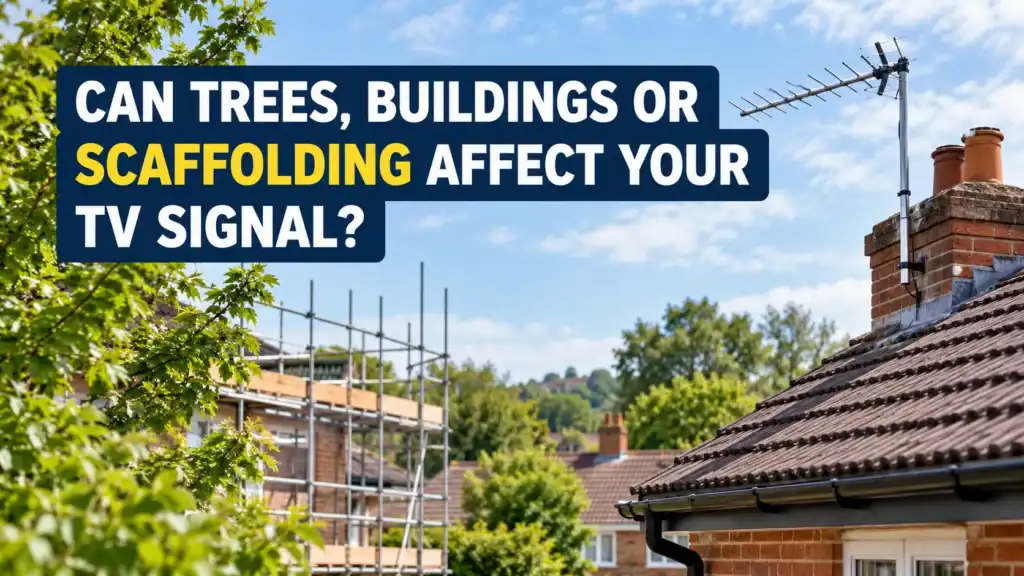
Trees, nearby buildings, rooflines, scaffolding, cranes, extensions and even seasonal leaf growth can all affect TV reception. In some cases, the aerial system itself may be fine, but the signal path to the transmitter has changed.
This can be especially frustrating because the problem may appear suddenly. Your TV worked properly for years, then one day channels begin to break up, disappear, or show “no signal”. Nothing inside the house has changed, so it feels like the fault has come from nowhere.
In reality, something outside the property may have changed.
How Your TV Aerial Receives a Signal
A TV aerial is designed to receive signals from a transmitter. For the best results, the aerial needs to be in the right position, pointing in the right direction, and receiving a signal that is strong and clean enough for reliable Freeview reception.
The signal does not need a perfect empty path in every case, but obstacles can make a difference.
Hills, trees, buildings, rooflines and other structures can weaken, reflect or disrupt the signal. Sometimes the effect is minor. Other times, it can be enough to cause pixelation, freezing, missing channels or intermittent reception problems.
This is why two homes on the same road can sometimes get different results. One house may have a clear line of sight towards the best transmitter, while another may be affected by trees, nearby buildings or the shape of the surrounding area.
If you are experiencing weak, unstable or missing channels, our Fix My TV Signal section covers the most common causes of TV and Freeview reception problems.
Can Trees Affect Your TV Signal?
Yes, trees can affect TV reception.
A single small tree is unlikely to cause major problems on its own, but large trees, dense branches or a line of trees between the aerial and the transmitter can weaken or disturb the signal.
The problem can also change with the seasons. In winter, a tree may cause little trouble because the branches are bare. In spring and summer, leaves grow back and create a denser barrier. That can sometimes make reception worse at certain times of year.
Wind can also make tree-related problems more obvious. If branches move in front of the signal path, the reception may come and go. The TV may be fine one minute and breaking up the next.
This kind of fault can look random, but there may be a pattern. If your TV signal gets worse in windy weather, or if the problem appears during the leafier months, trees may be part of the issue.
Can Buildings Block a TV Signal?
Nearby buildings can also affect TV signal.
A new building, extension, loft conversion, roof alteration or large structure can change how the signal reaches your property. It may block part of the signal, reflect it, or create a weaker and less stable reception path.
This can happen even if the building is not directly next door. The important thing is whether it sits in the signal path between your aerial and the transmitter.
In some areas, a building may not fully block the signal but may reduce the quality enough to make Freeview unreliable. Digital TV can appear perfect until the signal drops below a usable level. Then the picture can suddenly break up, freeze or vanish completely.
That is why a building-related signal problem can seem dramatic, even if the actual change in signal level is quite small.
Can Scaffolding Affect TV Reception?
Yes, scaffolding can affect TV reception, especially if it is close to the aerial or positioned between the aerial and the transmitter.
Scaffolding is metal, and large metal structures can interfere with TV signals. It may block, reflect or disturb the signal enough to cause picture break-up, missing channels or intermittent reception.
This can be particularly confusing because scaffolding is usually temporary. The TV may work normally before it goes up, become unreliable while it is there, and then improve again once it is removed.
However, if scaffolding or roof work has disturbed the aerial, cable or mounting, the problem may remain even after the scaffolding has gone. The aerial may have moved slightly, a cable may have been damaged, or a connection may have been loosened.
So if your signal problems started after scaffolding went up or after building work took place, it is worth having the aerial system checked properly.
Why Problems May Only Affect Some Channels
TV channels are broadcast in groups. This means a reception problem may affect some channels more than others.
You may find that BBC channels are fine but ITV or Channel 4 breaks up. Or you may lose certain Freeview channels while others continue to work normally.
This does not always mean the TV is faulty. It may mean that one group of channels is being received less reliably than another.
Obstacles such as trees, buildings or scaffolding can sometimes affect signal quality in uneven ways. The aerial may still receive enough signal for some channels, while others become borderline.
This is one reason why simply saying “the aerial works” or “the aerial does not work” can be misleading. The real issue may be signal quality, not just whether a signal exists.
Why the Problem May Come and Go
Obstacle-related signal problems are not always constant.
Trees move in the wind. Weather changes. Atmospheric conditions shift. Scaffolding may be moved during building work. Cranes may be present on some days and not others. Moisture, rain and damp can also make an already weak setup more unreliable.
This can make the TV signal seem unpredictable.
The picture may be fine in the morning and poor in the evening. It may break up only in bad weather. It may be worse when it is windy. It may improve for a few days and then come back again.
If the signal is already close to the minimum level needed, small changes can push it over the edge. That is why intermittent TV signal faults often need proper testing rather than guesswork.
The Aerial May Need Realigning
If something has changed around your property, the aerial may need adjusting.
A professional engineer can check whether the aerial is still pointing towards the best transmitter and whether a different aerial position would give a stronger or cleaner signal.
Sometimes even a small change in position can improve reception. Raising the aerial, moving it to a different part of the roof, correcting the alignment, or improving the mounting may help.
In other cases, the existing aerial position may still be fine, but another part of the system may be causing the problem. The cable, wall plate, splitter, amplifier or fly lead may also need checking.
The important point is that the aerial system should be tested before deciding what needs replacing.
Find out more about our TV aerial installation and repair service.
Could the TV Be Picking Up the Wrong Transmitter?
If buildings, hills or trees affect the signal from the preferred transmitter, the TV may sometimes pick up signals from another transmitter instead.
This can happen during an automatic retune, especially if more than one transmitter can be detected at your property.
The result may be missing channels, duplicate channels, channels in the wrong order, or the wrong regional news appearing on screen.
In this situation, the problem is not just a weak signal. It may also be a tuning or transmitter-choice issue. The aerial may need aligning to the correct transmitter, and the TV may need tuning properly once the signal is stable.
We explain this in more detail in our guide to why your TV may be picking up the wrong transmitter.
Why Boosters Are Not Always the Answer
If an obstacle is affecting the signal before it reaches the aerial, a booster may not solve the problem.
A booster can sometimes help if the signal is suitable for amplification, but it cannot magically create a clean signal where the incoming signal is poor quality. If the signal has already been distorted, reflected or weakened by obstacles, boosting it may simply amplify the problem.
In some cases, a booster can even make things worse by overloading the TV tuner or amplifying interference.
This is why signal testing matters. The right solution may be aerial realignment, better cabling, improved distribution, a different aerial position, or a repair to the existing system. A booster is only useful when it is the right tool for the fault.
What to Check Before Calling an Engineer
If your TV signal has suddenly become unreliable, think about what has changed nearby.
Has a tree grown taller or become denser during spring or summer? Has scaffolding gone up nearby? Has a neighbour had building work done? Has a new extension, loft conversion, roof structure or large building appeared in the signal path?
Has there been recent work on your own roof, chimney, fascia, guttering or loft?
Also make a note of when the problem happens. Is it worse in wind? Does it happen after rain? Is it seasonal? Does it affect every TV in the house, or only one room?
These clues can help narrow down the likely cause.
What an Engineer Will Usually Check
An engineer will usually test both signal strength and signal quality. Both matter.
A signal can be strong enough to detect but poor quality, which can still cause freezing, pixelation and missing channels. The engineer may check the signal at the aerial, at the cable entry point, at any splitter or amplifier, at the wall plate and at the TV itself.
They may also check the aerial direction, aerial condition, cable condition, mounting, connections and whether the aerial is still suitable for local reception conditions.
If trees, buildings or scaffolding are affecting the signal, the engineer can advise whether realignment, relocation, repair or replacement is the most sensible option.
Do You Need a New Aerial?
Not always.
If the aerial is still in good condition, it may only need realigning, repositioning or reconnecting properly. If the problem is caused by damaged cable, a poor wall plate, a faulty booster or a bad splitter, the aerial itself may not need replacing.
However, if the aerial is old, corroded, damaged, poorly positioned or unable to receive the best available signal, a new aerial may be the better long-term solution.
The aim is not simply to replace equipment. The aim is to get a reliable signal that works properly in normal day-to-day use.
Our guide Do I Need a New TV Aerial or Can My Existing One Be Repaired? explains the options in more detail.
Need Help With TV Signal Problems Caused by Trees, Buildings or Scaffolding in Sussex?
Local TV Aerials & Satellite Services can check your aerial system and find out whether your signal problem is being caused by trees, nearby buildings, scaffolding, aerial alignment, cabling, tuning or another fault.
We can test the signal, inspect the aerial, check cables and connections, look at splitters and boosters, and advise whether you need a repair, realignment, improved distribution, new cable or a replacement aerial.
We cover TV aerial repairs, Freeview problems and signal fault finding across East Sussex and West Sussex, including Brighton, Hove, Lewes, Eastbourne, Seaford, Newhaven, Peacehaven, Uckfield, Haywards Heath, Burgess Hill, Horsham, Crawley, Hailsham, Bexhill and surrounding areas.
If your TV signal has become unreliable after trees have grown, scaffolding has gone up, or building work has changed the area around your home, get in touch and we can help you find the most sensible fix.
