Can 4G or 5G Interfere With Freeview TV Reception?
TV Aerials Help
If your Freeview signal suddenly starts breaking up, it is natural to think the aerial has moved, the TV needs retuning, or the weather is causing trouble. Sometimes that is true. But there is another possible cause that people do not always think about: mobile signal interference.
Can 4G or 5G Interfere With Freeview TV Reception?
In some cases, 4G or 5G mobile services can interfere with TV reception received through a traditional aerial. This does not mean mobile networks are always to blame when your TV picture breaks up, but it is one of the possible causes an engineer may need to consider.
If your TV signal has become unreliable and nothing obvious has changed inside the house, interference from nearby mobile signals may be worth checking.
For general help with unreliable Freeview reception, visit our Fix My TV Signal page.
How Can Mobile Signals Affect Freeview?
Freeview TV is received through a TV aerial. The aerial picks up broadcast signals from a transmitter and sends them through the cable to your television or set-top box.
Mobile services also use radio signals, but on different frequencies. In most cases, these services work without causing problems for TV reception.
However, in some situations, strong nearby mobile signals can interfere with a TV aerial system. This is more likely if the aerial, amplifier, booster, cabling or TV equipment is sensitive to those signals.
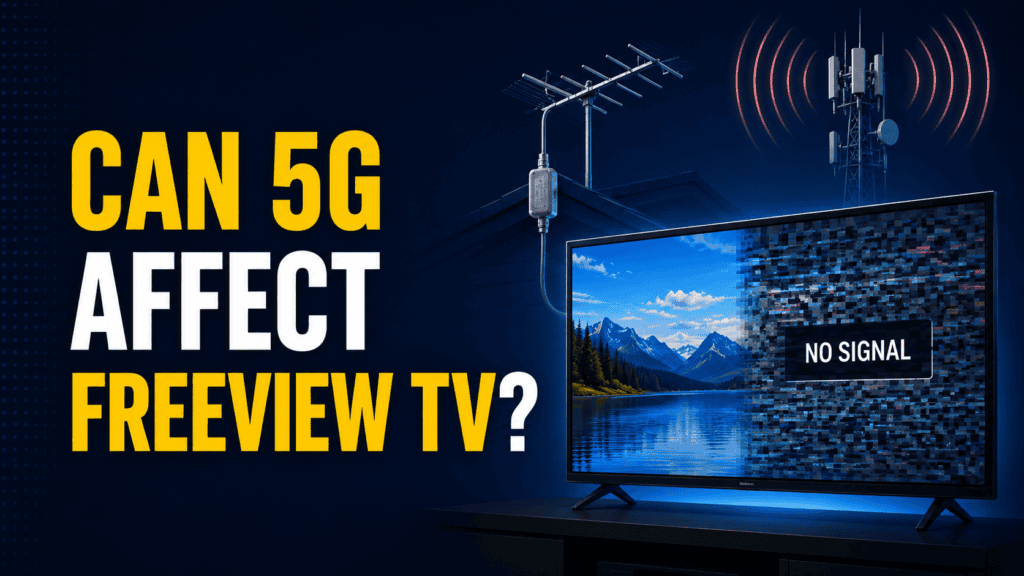
The result can look like an ordinary TV aerial fault. You may see pixelation, freezing, sound dropouts, missing channels or a “no signal” message.
That is why it is important not to guess. The same symptoms can be caused by weak signal, poor cabling, aerial alignment, water ingress, a faulty booster, transmitter choice or interference.
Signs That Interference May Be Involved
There are a few clues that mobile signal interference could be part of the problem.
Your TV may have worked well for years and then suddenly started breaking up without any obvious change to your aerial or TV setup.
The problem may affect some channels more than others. You may find that certain Freeview channels pixelate or disappear while others continue to work normally.
The issue may be worse at certain times, or may seem to come and go. In some homes, the picture may be fine for a while, then suddenly break up or freeze.
You may also notice that the problem began around the time mobile network work took place nearby, although this is not always obvious to the homeowner.
These signs do not prove that 4G or 5G interference is the cause. They simply mean it is one possible explanation that should be checked.
If your TV signal is intermittent, our guide to why your TV signal comes and goes at different times of day may also help.
It May Not Be the Mobile Signal Itself
One important point is that 4G or 5G interference is not always the fault of the mobile signal alone.
Often, the underlying problem is that the aerial system is not coping well with unwanted signals. This may be because of an old amplifier, a poor-quality booster, damaged coaxial cable, loose connections, badly screened cable, or an aerial system that was installed before nearby signal conditions changed.
A good aerial system should receive the correct TV signal and reject unwanted interference as far as possible.
If the system is old, damaged or poorly set up, it may be more vulnerable to interference from several sources, including mobile signals, electrical equipment or other local signal issues.
Why Boosters Can Make the Problem Worse
A signal booster sounds like a sensible fix when the TV signal is breaking up. But if interference is involved, a booster can sometimes make things worse.
A booster amplifies signals. If it is receiving the correct TV signal cleanly, that can be useful in the right setup. But if unwanted mobile signals or interference are also entering the system, the booster may amplify those as well.
This can overload the TV tuner or create a poor-quality signal, even if the signal strength appears high.
This is why adding a booster without testing the system can be a gamble. The problem may not be that the signal is too weak. It may be that the signal is contaminated, overloaded or being distorted.
In that situation, more amplification is not the answer.
We explain this in more detail in our guide: TV signal booster: when it helps and when it makes things worse.
Can a Filter Help?
In some cases, a filter can help reduce interference from mobile signals before it reaches the TV or amplifier.
A filter is designed to block unwanted mobile frequencies while allowing the TV signal through. If mobile interference is the cause of the problem, fitting the correct filter in the right place can improve reception.
However, a filter is not a magic fix for every Freeview problem.
If the fault is caused by a damaged aerial, poor alignment, water in the cable, a faulty wall plate, weak signal, wrong transmitter, or a failing booster, a filter may not solve it.
That is why the fault needs to be diagnosed properly. A filter may be part of the solution, but only if the problem is actually interference from the relevant mobile signals.
Why Some Homes Are Affected and Others Are Not
One house may have mobile signal interference while another nearby home has no problem at all.
This can seem confusing, but there are several reasons it can happen.
The aerial may point in a slightly different direction. One property may have a clearer signal from the TV transmitter. Another may have older cable, a weaker aerial system, a different booster, or more splitters feeding extra rooms.
The position of the aerial also matters. A roof aerial, loft aerial or distribution system may all behave differently depending on signal strength, cable quality and the surrounding environment.
Even two houses on the same road can have different reception conditions because of trees, rooflines, buildings, hills, scaffolding or other local obstacles.
This is why TV signal problems are often very property-specific.
For more on outside obstructions, see our guide to whether trees, buildings or scaffolding can affect your TV signal.
Mobile Interference or Weak TV Signal?
Mobile interference can look similar to a weak TV signal problem.
Both can cause pixelation, missing channels, freezing and no signal messages. Both may affect some channels more than others. Both may come and go.
The difference is in what the signal test shows.
A weak signal problem usually means the TV aerial is not receiving enough usable signal, or the signal is being lost through cable, splitters or poor connections.
An interference problem may show that the TV signal is present, but the quality is being affected by unwanted signals, overload or noise.
A professional signal test can help identify whether the problem is strength, quality, interference, cabling, amplification or aerial alignment.
Should You Retune the TV?
If the picture is breaking up, many people immediately retune the TV.
This is not always the best first step.
If the signal is weak, unstable or affected by interference, retuning can make the channel list more confusing. The TV may fail to store channels, store weaker versions, pick up the wrong transmitter, or place duplicate channels in the 800s.
If you suspect interference or an unstable signal, it is usually better to find and fix the signal problem first.
Once the signal is stable, a retune is much more likely to work properly.
You may also find our article on why TV channels disappear after a retune useful.
Could 5G Affect a TV Aerial in Sussex?
It can be one possible cause, but it should not be assumed automatically.
Across Sussex, TV reception can be affected by several things: transmitter choice, coastal conditions, trees, buildings, hills, aerial alignment, cabling, boosters, splitters, wall plates and weather exposure.
Mobile signal interference is another possible factor, especially where the aerial system is vulnerable or where nearby mobile services have changed.
The key is to test the system properly rather than blaming one cause too quickly.
For homes in Brighton, Hove, Lewes, Eastbourne, Seaford, Newhaven, Uckfield, Haywards Heath, Horsham, Crawley, Burgess Hill, Hailsham, Bexhill and surrounding areas, local conditions can vary from property to property.
That is why the right fix depends on what is actually happening at your address.
If transmitter choice may be involved, read our guide to why your TV might be picking up the wrong transmitter.
What an Engineer Will Usually Check
An engineer will normally check both signal strength and signal quality. Both are important.
They may test the signal at the aerial, at the cable entry point, at any splitter or amplifier, at wall plates and at the TV itself.
They may also check whether the aerial is aligned correctly, whether the TV is tuned to the right transmitter, whether the cable is in good condition, and whether a booster or amplifier is helping or making the problem worse.
If interference is suspected, they can check whether the system may need a suitable filter, better screened cable, removal of a faulty booster, improved distribution or other corrective work.
The aim is to find the actual cause of the reception problem rather than replacing parts at random.
What You Can Check Before Calling an Engineer
There are a few simple things you can check first.
Make sure the aerial lead is properly connected to the TV and wall socket. Try another fly lead if you have one. Check whether the problem affects one TV or every TV in the house.
If you have a booster, check whether it is powered and connected properly. If safe and practical, you may be able to test whether the signal behaves differently with the booster removed, but do not disturb anything you are unsure about.
Make a note of when the problem started and whether it affects certain channels more than others.
If the issue appeared suddenly and the usual checks do not help, it is worth getting the system tested properly.
Do You Need a New Aerial?
Not always.
If 4G or 5G interference is part of the problem, the solution may be a filter, improved cabling, removal or replacement of a booster, better screening, or changes to the way the signal is distributed.
If the aerial is old, damaged, poorly aligned or unable to receive a clean signal, a repair or replacement may be needed.
But a new aerial should not be the first assumption.
The best solution depends on the condition of the aerial system and what the signal test shows.
For more help deciding, see our guide: do I need a new TV aerial or can my existing one be repaired?
Need Help With Freeview Interference Problems in Sussex?
Local TV Aerials & Satellites can check your TV aerial system and help find out whether your reception problem is caused by mobile signal interference, weak signal, aerial alignment, cabling, boosters, tuning or another fault.
We can test the signal, inspect the aerial, check cables and connections, look at splitters and boosters, and advise whether you need a filter, repair, realignment, improved distribution, new cable or replacement aerial.
We cover TV aerial repairs, Freeview problems and signal fault finding across East Sussex and West Sussex, including Brighton, Hove, Lewes, Eastbourne, Seaford, Newhaven, Peacehaven, Uckfield, Haywards Heath, Burgess Hill, Horsham, Crawley, Hailsham, Bexhill and surrounding areas.
If your Freeview signal has started breaking up, disappearing or showing no signal for no obvious reason, get in touch and we can help you find the most sensible fix.
4G, 5G and Freeview Interference FAQs
Can 5G interfere with Freeview TV reception?
In some cases, nearby mobile services can interfere with Freeview received through a TV aerial. It is not always the cause of picture break-up, but it is one possible issue to check if the signal has suddenly become unreliable.
Can 4G cause TV signal problems?
Yes, 4G mobile signals can sometimes affect TV aerial systems, especially if the system uses older cable, a poor-quality booster, an amplifier, or equipment that is sensitive to unwanted signals.
Will a filter fix Freeview interference?
A suitable filter can help if mobile signal interference is the cause. However, a filter will not fix problems caused by aerial damage, poor alignment, water ingress, weak signal, wrong transmitter tuning or faulty cabling.
Should I retune my TV if I think 5G is affecting Freeview?
Not straight away. If the signal is unstable or affected by interference, retuning can remove channels or store weaker versions. It is usually better to diagnose the signal problem first, then retune once reception is stable.
Do I need a new aerial if mobile interference is affecting my TV?
Not always. The solution may be a filter, better screened cable, improved distribution, removal of a faulty booster, or a repair. A new aerial may only be needed if the existing system is old, damaged, poorly aligned or unable to receive a clean signal.
